
The Last Planner System (LPS) is a working method based on the “Lean Production” philosophy that involves working directly on the final link in the activity planning chain. The Comprehensive Community Educational Project (PEIC, by its acronym in Spanish) in the Venezuelan educational sector defines the strategies of school management, integrating pedagogical, political, sociocultural and community principles. The central axis of this essay lies in the implementation of elements of the LPS methodology to improve the organization and execution of the PEIC. It is intended to make a critique that allows dissertation on the execution of the PEIC and why they tend to be repeated cyclically in educational establishments without achieving satisfactory results. The transcendental is the incorporation of new concepts and combining the best of each method, complementing each other and increasing the reliability of planning with the purpose of improving performance and therefore the execution of the project.
El Sistema Último Planificador (SUP) es un método de trabajo basado en la filosofía “Lean Production” que involucra trabajar directamente el eslabón final en la cadena de planificación de actividades. El Proyecto Educativo Integral Comunitario (PEIC) en el sector educativo venezolano define las estrategias de la gestión escolar, integrando los principios pedagógicos, políticos, socioculturales y comunitarios. El eje central de este ensayo radica en la implementación de elementos de la metodología del SUP para mejorar la organización y ejecución del PEIC. Se pretende realizar una crítica que permita disertar sobre la ejecución de los PEIC y del por qué tienden a repetirse de manera cíclica en los planteles educativos sin lograr resultados satisfactorios. Lo trascendental es la incorporación de nuevos conceptos y combinar lo mejor de cada método, complementándose e incrementando la confiabilidad de la planificación con el propósito de mejorar los desempeños y por ende la ejecución del proyecto.
Since time immemorial, the human being has searched and found the ways to achieve the goals that he sets for himself, and in that process, with the passing of the centuries, could realize that, once the need to achieve them occurred, he must have a plan, that is, to systematically follow a series of steps methodically formulated in such a way that the ultimate purpose is the goal satisfactorily achieved.
In the same way, he was able to realize that this series of steps includes the correct decision making, the concentration of efforts, the coordinated action and the meticulous control, which he applied to innumerable daily activities (at the micro level) and could extend them to goals or objectives of great relevance (at the macro level) in any area where he worked, it is clear that with more methodical systemic approaches according to the sphere of influence (home, work, organizations, companies, schools, communities, to name a few examples). So, the human being began to plan.
In the new ages, planning was considered an effective control tool, an instrument for communicating the objectives of organizations and a mechanism for verifying commitment in the execution of agreed plans. But the planning, considered by many to be rigid and invariable, had to be adjusted to unforeseen events, to fortuitous and unavoidable situations; this is how strategic planning was born, which allows the revision of the plans during the process of execution of the activities and if it is necessary to modify them, for the total achievement of the objectives.
In modern times, scholars in the area of management and administration, and therefore of strategic planning, have postulated what has been called modern theories of administration and management, giving it names such as Total Quality, Reingineering, Benchmarking, Empowerment, Outsoursing, Dowsizing, Rightsizing, all addressing the business area, but transferring to other areas or sectors of human endeavor.
This critical essay focuses on strategic planning in a part of the Venezuelan educational sector, in the primary school specifically in the so-called Comprehensive Community Educational Project, and in an aspect of the business sector on the Last Planner System methodology. It is developed with the initial description of the elementary foundations of each of the methodologies, an attempt is made to establish analogies between such foundations and how elements of the latter can be implemented for the optimization of the former.
The Last Planner System (hereinafter referred to as LPS) for Womack and Jones (cited in Rodríguez, Alarcón and Pellicer, 2011) it is a working method based on the "Lean Production" philosophy, which is based on the creation of a flow to deliver the maximum value for its clients using a minimum of necessary resources, with which it seeks to achieve a continuous work flow and a decrease in losses or tasks that do not add value. The LPS it has the following characteristics:
With the LPS, the aim is to bring the general objectives of a project to the reality of day to day, dividing the planning by scope and zones, applying cascading tools. In this regard, Ballard (cited in Sanchis 2013) organizes three levels: Main Program or Master Schedule (which is long-term planning), Lookahead Program (medium-term planning) and Weekly Work Plan (which is carried out weekly).
The Master Schedule defines the tasks that "should" be done, provides an overview of the planning; each and every one of the project's activities converges in it, setting deadlines and establishing its scope. The Lookahead defines what "can" be done in the established time according to the characteristics of the project; it deepens the planning of the activities in an intermediate term.
In this program, the necessary resources for the development of the programmed activities are clearly determined, the term established to execute them and their availability; in turn, those responsible for each activity must be incorporated. Subsequently, the restrictions associated with each of these activities are identified (restrictions that must be eliminated so that they do not delay the development of the established schedule), those responsible and the dates of their elimination. The person responsible for eliminating the restrictions, in turn, is in charge of executing the associated activities (Ballard, 2000).
In the Weekly Work Plans, defines what "will” be done during the coming week based on the objectives met in the previous planning, those foreseen in the Lookahead and the existing restrictions. For this to be carried out successfully, weekly meetings must be established where the conclusions obtained provoke feedback that allows modifications to be made to the Lookahead or the Master Schedule.
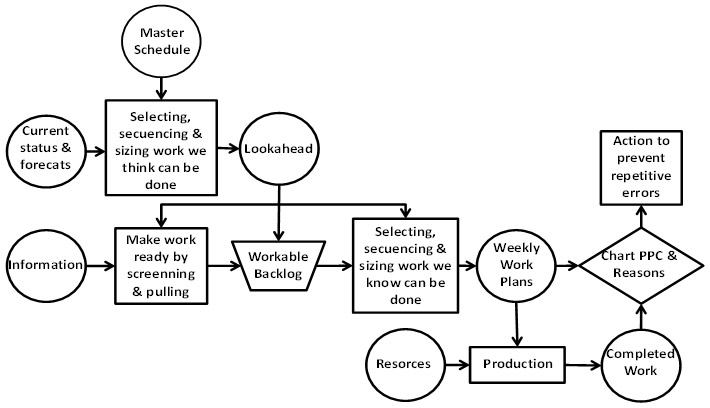
Therefore, it can be said that this system seeks to increase the reliability of planning by improving uncertainty control (taking actions at the different levels of the planning system) and consequently, executions are improved. Planning is conceived based on restrictions; therefore, all activities have difficulties that must be overcome in order to be carried out, consequently the more restrictions are overcome, the more activities will be executed, which seems complicated and to understand all of the above I recommend analyzing it in the following figure:
Figure 1. LPS work methodology
Now, the most relevant thing about LPS is that this system is based on working directly with the last planner, and who is this? Usually it is usually the executing foreman of the project, but it can also be the project manager, the supervisor, among others, depending on who is the final link in the activity planning chain. This planner is the one who defines what will be done and who will do it, he is the person who directly monitors the work done, its performance and its quality.
To understand how LPS works, the following must first be known: traditionally, when planning to execute an activity or job, the person who plans does so based on what must be done, assuming that all the necessary resources for the execution are available when the time comes to use them, leaving aside if they can really be carried out, are planned and already.
When the execution arrives, the executors find themselves lacking the minimum resources necessary to carry it out, initiating an improvised on-site replanning, with which to try to make what is planned coincide with what is executed and that the famous "real curve" (curve red) of execution is as close as possible to the “ideal curve” (blue curve) of planning, otherwise, the executors are guilty of the non-compliance with the planning, not the planner.
The matter seems a bit convoluted, but that's how things happen; from the above it is necessary to understand the following, it is planned to avoid improvisations, therefore, what “should” be done (the plan) and what “will” be done (the execution) are directly proportional. What "can" be done (the executable) is not an option. I emphasize these three words "must", "can" and "will" because they are the fundamental basis of all planning, especially in LPS.
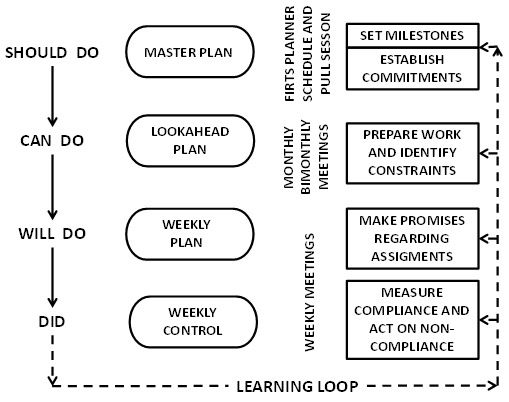
This inconsistency between what "must", what "can" and what "will” be done, is resolved through the cascade planning or programming (already mentioned) proposed in the LPS, where in the Master Schedule determines what “must” be done, In the Lookahead , the work is prepared and the restrictions are reviewed, thus having the knowledge of what really "can" be done and the Weekly Work programs the activities that can be executed, what "will” be done, thus committing those involved to compliance with the program. Now, to better illustrate the LPS planning process, the following graph is presented:
Figure 2. Last Planner work system
When the activities for some reason were not carried out, the reasons why they could not be completed must be investigated, for which the causes of non-compliance are sought, since these are the first steps to generate an improvement. The important thing in the LPS is to detect the problems in advance; in this way there would be enough time to solve them, which guarantees that there are no obstacles that delay the start of the execution of the activities.
In the perspective of strategic planning, but in the Venezuelan educational sector, in 2005, the Ministry of Education of the Bolivarian Republic of Venezuela adopts the Comprehensive Community Educational Project (hereinafter referred to as PEIC by its acronym in Spanish) in order to attend to the Educational Policy of the level of Basic Education (primary) and thus transform the School as a Whole:
As a product of collective construction, it implies observation and research, planning, coordination, for the execution and evaluation of all those actions planned to achieve the proposed objectives at the academic, administrative and community level, with the purpose of achieving a comprehensive education, diversified, quality for all” (MECD, 2005).
Conceptualized then as a project that defines the strategies of school management, integrating pedagogical, political, sociocultural and community principles. Today it is present throughout the Basic Education Subsystem made up of the levels of initial education, primary education and secondary education. The PEIC, as a pedagogical project, is planned to be carried out from action-research, participatory and transformative, of permanent collective construction between the entities that make life in the educational institution and its community where it is immersed, to manage the activities that allow their needs and problems to be met, strengthen the experiences achieved and incorporate new proposals that promote the required transformations.
It is established as an evolution of its predecessor, the Plantel Pedagogical Project (PPP), which Sánchez (2000), “arises in France in 1982 as a coherent set of objectives, methods and particular means that the school institution defines in order to participate in national objectives" (p. 2), subsequently extended to the countries of Latin America, and in Venezuela it is implanted and developed from 1996 as a coherent set of objectives, methods and particular means that the educational institution defines in order to participate in national objectives.
We can understand then, that like its predecessor, the PEIC is the expression of the educational policy of the school, since its development and execution require, in an effective way, that its main actors assume their co-responsibilities, recognize their potentialities and weaknesses and propose strategies to troubleshoot. Well known and built by teachers who work in schools, high schools and technical schools in Venezuela, for its preparation, the PEIC is structured in five (05) moments, namely:
It should be noted that as a result of the Planning phase or moment, an action plan arises to define and organize the activities and actions that allow the proposed objectives to be achieved as a group. Tasks, resources, time and those responsible for executing the actions are taken into account, which makes it possible to collectively establish strategies to obtain satisfactory solutions, specify what you want to achieve, how far you want to go and who you have.
The Evaluation moment, being permanent, encourages reflection on the planned actions to execute the activities in addition to their feasibility and the fulfillment of the acquired commitments, which allows making adjustments in the strategies for approaching the execution of each activity, thus improving the processes. In this way, the condition of collective expression of the PEIC is reaffirmed as a space for dialogue and the participation of the entire educational community (students, fathers, mothers, representatives and managers, teachers, administrative staff and workers, community in general) and as a form of articulation of school management.
Seen in this way, the PEIC is a powerful tool for educational management, and in theory it should provide solutions in the long, medium and short term, in a school year, allowing situations or problems that have not arisen to be resumed in the next school period could be resolved. However, it has been observed (according to the experience of the author of this essay in his internship as Coordinator of Permanent Training and the experience of many colleagues) that in practice, over the years, the same situations manifested in each PEIC, that is, that the problematic situations are maintained over time.
The foregoing could be due to poor school management (which cannot be measured only by this indicator), however, this is not the case, rather it is indicative of deficiencies in the execution of the project, since most of them are problems whose solutions are beyond the budgetary and financial scope of the educational community in general. Or simply the PEIC is only carried out and not executed, it is only built to comply with the guidelines of the educational regent; here we find the famous “meets-lies”.
In this sense, it has been left to schools to solve problems that are beyond their reach, such as major repairs to infrastructures, furnishing, construction of structures such as sports fields, removal and supply of a whole network of sanitary installations, among many. Therefore, the biggest obstacle is not in school management, nor in the fact that its main actors have not assumed their responsibilities and are not aware of their potentialities and weaknesses, but it is in the execution (according to the author's criteria).
The foregoing gives rise to the following question: why in the execution? The answer is very simple: the PEIC is conceived as a project that is carried out from the perspective of research, and thus its execution is planned, efficient and effective, in theory (on paper, as it is said colloquially). It does not matter if it is from action research or another type of research, but it is planned and executed starting from the premise that it is an investigation. From this point of view, the PEIC must be seen and approached as an execution project and it must be planned accordingly.
Another addition to the reiterative existence of the same PEIC each school year is that the pedagogical guidelines issued by the Ministry of Education must be incorporated into its planning, orientations to which greater weight is given (even if they are decontextualized) therefore in school activities these premises are sine qua non requirements, which directly influences the planning and execution of activities.
In light of the above, it can be understood that in the PEIC the tasks to be executed are planned based on what “should” be done, assuming that the resources will be available when they are needed or are easily acquired, or cost a little but can be achieved, regardless of their size, that is, if it “can” be done (sometimes goals are set that are drawn of the dream world). This has the consequence that what “shall” be done is inconsistent with what “should” be done, causing non-compliance with planning and its consequent improvisation.
Unfortunately, this is the reality of many educational institutions, because for the planning of the PEIC, comprehensive training environments are constituted (work commissions) who end up planning and pressing for its execution are the directors of the school institution, that is, the manager becomes the last planner, leaving a large number of potential last planners who can guarantee a correct execution.
The LPS refers to planning, defining what will actually be done and how it will be executed, in addition to controlling and verifying that it happens, however, it is the people involved that make it possible for any method to work. The LPS is a collaborative cascade planning system based on commitment and whose main purpose, in addition to controlling the project, is to reduce variability in execution through the application of four basic principles: personal commitment, coordination of the last planners through periodic meetings, use of a basic control indicator called Percentage of the Completed Plan (PCP) and public visibility of the weekly results obtained.
In this sense, the planning of the PEIC implementing the LPS must focus mainly on the management of what “can” be done, and thus the possibility of a true execution will be greater. For this, I consider it essential to implement the following actions:
From this point of view, a planned PEIC incorporating the characteristics of the LPS into its structure would help it meet the objectives for which it was built, without losing its pedagogical character. On the other hand, when the activities for some reason were not carried out, the reasons why they could not be completed must be investigated, for which the causes of non-compliance (CNC) are sought, which are the first steps to generate a substantial improvement and which in turn allows the elimination of activities that do not add value and that generate waste of resources, costs and deadlines.
Regardless of the area of origin, if the structures of the LPS and the PEIC are compared, it will be possible to see that they share many similarities (especially if each of them is studied in depth) but, as previously stated, the PEIC is conceived as a project that is carried out from the perspective of research and not of execution, while the LPS is carried out from the perspective of execution, hence its success.
Planning by taking actions at different levels of the planning system (Master Schedule, Lookahead and Weekly Work Plan) increases its reliability; adding to this the Percentage of Completed Assignments (PCA) and the Causes of Non-Compliance (CNC), allows evaluating and learning from the previous week's PCA. The real recognition of the restrictions inherent to an activity to be carried out allows, truly, determining if it is feasible to carry it out. It can be said then that an adequate planning system greatly improves the elimination of shortcomings in the execution of a project, with this strategic planning is optimized because it can detect in advance the weak points of the project and thus make decisions, correct on time.
The implementation of the LPS in the execution of the PEIC does not need more than an understanding of the forms of strategic planning, since the lack of training of the members of the educational community in the application of this methodology could constitute a problem when implementing the LPS in PEIC implementation process, because it is not enough just to change the management of the process, but the mentality of the members of the educational community of the institution must be changed. What is transcendent is the incorporation of new concepts and combining the best of each method, complementing each other and increasing the reliability of planning with the purpose of improving performance and therefore the execution of the project.
Ballard, H.G. (2000).The last planner system of production control. (Doctoral Thesis). University of Birmingham, Birmingham. Online abstract. http://www.researchgate.net/239062242_The_last_planner_system_of_production_control_pdf
COSAPI S.A. (2014). Procedure for implementing the planning system “The Last Planner”. http://www.intranet.cosapi.com.pe/fsfsmanualgestion/7.%20gestión%20por%20areas%20del%20proyecto/7.8.2.%20planeamiento/6.%20elab.%20e%20integración%20de%20programas%20interm.%20y%20sem/pcp-pr-0001%20rev1%20implementacion%20de%20last%20planner.pdf
Ministry of Education and Sports. (2005). PEIC a management that is built on de whole. Educere, vol. 10, number 34, july-september, 2006, pp. 549-552. Los Andes University.
Sánchez, J. (2000). School Pedagógical Projet. Reality and Progress.http://servicio.bc.uc.edu.ve/educacion/revista/a8n16/8-16-6.pdf
Sanchis, I. (2013). Last Planner System. A case study. https://www.academia.edu/3639744/Last_Planner_System_un_caso_de_estudio
Rodríguez, A.; Alarcón, L.; Pellicer, E. (2011).The management of the work from the perspective of the Last Planner.Public Works Magazine, 3518, 158. https://www.researchgate.net/publication/318682002_La_gestion_de_la_obra_desde_la_perspectiva_del_ultimo_planificador