
The objective was to interpret the meaning of the pedagogical practice that teachers carry out to carry out an industrial technical education oriented toward innovation, in the context of the Industrial Technical School “La Carucieña” in the city of Barquisimeto, Venezuela. The interpretive ethnographic method was used in the qualitative methodological perspective; participant observation was used in classrooms and workshops, and the in-depth interview of five teachers was used. The coding and categorization procedure resulted in two guiding categories: (a) Innovation in the pedagogical act of the Industrial Technical Schools, and (b) Pedagogy of Learning for Innovation, to which the hermeneutic process was carried out. As a final reflection it is necessary that the essence of the innovative being in the pedagogical act is the teacher, because his students will be the reflection of the attitude towards the need to improve, to incorporate changes and the dedication to overcome the education of routine and inertia.
El objetivo fue interpretar el significado de la práctica pedagógica que los docentes realizan para llevar a cabo una educación técnica industrial orientada hacia la innovación, en el contexto de la Escuela Técnica Industrial “La Carucieña” en la ciudad de Barquisimeto, Venezuela. Se empleó el método etnográfico interpretativo, en la perspectiva metodológica cualitativa; se utilizó la observación participante en las aulas y talleres, y la entrevista en profundidad a cinco docentes. El procedimiento de codificación y categorización generó como resultado dos categorías orientadoras: (a) La innovación en el acto pedagógico de las Escuelas Técnicas Industriales, y (b) Pedagogía del aprendizaje para la innovación, a las cuales se realizó el proceso hermenéutico. Como reflexión final se tiene que la esencia del Ser innovador en el acto pedagógico es el docente, pues sus estudiantes serán el reflejo de la actitud hacia la necesidad de mejorar, de incorporar cambios y de la dedicación a sobrepasar la educación de la rutina y la inercia.
Education represents an authentic search for continuous improvement for all societies in the world, an opportunity to articulate knowledge structures, take on challenges, and promote progress, development, and well-being in citizens. At the same time, one of the educational modalities that aspire to be a factor of innovation, productivity, change for the development and socio-economic well-being of the population is technical education. For several years in Latin America, specifically this educational modality, that is why it has sought to expand its function, in the sense that it should work to educate students and have an impact on the development of families and their surroundings.
From this perspective, technical schools can represent a mediating function in order to become the space for affective, supportive, trustful, and innovative encounter, which favors the formation of cooperative social relations while fostering profitable and attractive means for creative learning, to emphasize training for work as a generating force for the development that nations need.
In addition, the productive world concerns must be taken into account, in terms of innovation, technology, and services. Which tend insistently to the globalizing search for educational alternatives, enriched with a humanizing and ecological component, progressively replacing the simple, productive vision of organizations with another vision of more significant social and human content, which does not exclude and less demarcates the technical education process.
This vision is opposed to the economistic position, where training for work responds to productive and replicating interests of a predominant structure based on socio-economic employability, which can be reflected in the statement of Calderón (2002), indicating that social strategies aimed at solving the economic inequalities of the population would be located in education for work. For this, it is expected that the new workers will permanently develop technical and professional skills that make them employable and capable of adding value to their job. People with more intellectual, communication, and teamwork skills. Workers who earn their bread with the sweat of their minds.
However, it is not about training workers by the fact that they are only able to get a job and get reasonable remuneration. On the contrary, there must be an integrating process where the competence to develop a trade is combined with the humanizing vocation (consciousness of being) and social (for a consciousness toward the other). This type of perspective guides training for work, which persists today, seems to be characterized by defending the increase in material wealth at the expense of human wealth. However, not even if it turns out to be sustainable, material growth would be insufficient if it does not incorporate and impregnate human quality since the essence of development must consist of all human beings living better. That is, development planning must consist of the integral progress of the being for life.
From this approach, since the last decade of the 20th century, as Simone (1993) points out, the need for training for the job and technical instruction there was already; as a space that would lead to lifelong learning. Among other aspects of vast access to information, analysis, and interaction with the economic and social environment, added to innovative learning, supported by training, integration, and self-learning. All of this would be enhanced if they stimulate personal values such as determination, perseverance, curiosity, or creativity in logical and analytical processes, enabling participation, reflection, criticism, and innovation.
This is how pioneering organizations in this educational modality, such as the Fe y Alegría International Federation (1995), has also been proposing at the end of the 20th century that, even when education is fundamentally oriented towards human, labor and political training that generates wealth and guarantees its equitable distribution, Education in and for work implies building an educational design that offers students opportunities to create and produce changes, allowing them to gain spaces for actual participation in society to transform it (Fe y Alegría, 1995). Twenty years later and in the middle of the century XXI, this aspiration continues validity, being appreciated in the Incheon Declaration at the World Education Forum, among other aspects, the following:
Our vision is to transform lives through education, recognizing the vital role of education as the primary driver of development and achieving the other proposed SDGs. (United Nations Educational, Scientific and Cultural Organization, UNESCO, 2015) Recognizing that education is key to achieving full employment and eradicating poverty. Within a lifelong learning approach, we will focus our efforts on access, equity, inclusion, quality, and learning outcomes. (UNESCO, 2015)
This demand was also embodied in the Agenda 2030 document, by stating in point 4 (United Nations, 2018) that the achievement of quality education is the basis for improving people's lives and sustainable development; and is therefore consistent with Target 4.4. It is necessary by 2030 to considerably increase the number of young people and adults who have the essential skills, particularly technical and professional ones, to access employment, decent work, and entrepreneurship (United Nations 2018). In this sense, it can be seen that the purposes of technical education, regardless of the historical factors, economic situations, and political traditions that condition its implementation in the countries, can be stated from at least three perspectives: economic, social, and sustainability (Seville, 2017).
That is why it emerges from this vision, the need for formal and non-formal dedicated to training for work to provide their students with a solid general scientific-technical training, which develops their intellectual skills; so, they can reason, propose and innovate (Simone, 1993). Therefore, their knowledge, values, attitudes, skills, competencies, and skills must be useful to improve themselves individually and contribute to the collective development and transformation of their educational, family, and social environment.
The linking of education and innovation as a way for development and social transformation is an approach that has been argued by some authors and international organizations such as Drucker (2000); White (2005); Robalino & Eroles (2010); Ibarrola (2010); Martín-Gordillo & Castro-Martínez (2014); Cobo (2016); UNESCO (2016), among others. In every day and academic discourses, it is appreciable that dimensions such as educational innovation, innovative education, educate for innovation, innovate to learn, innovative schools, among others, are incorporated by referring to the challenges and challenges of education at all levels and modalities, from its transformative role. According to Martín-Gordillo & Castro-Martínez (2014), there is a very close link between innovation and education, almost anthropological. The educational task involves transmitting the necessary tools for their incorporation into active life in society to children and young people. Hence, it is essential to innovate (more) to educate (better) is an idea commonly accepted for a long time and a clear demand towards educational systems and teachers. But innovation is not only an educational means but perhaps the primary purpose of education ”(Martín-Gordillo & Castro-Martínez, 2014).
By referring to innovation as an act linked to the learning process, UNESCO (2016) raises the innovation is based on learning. Insofar as it is connected to the transforming action of the world, it has a deep sense of change; since it produces characteristics that are not given by spontaneous generation because these must be organized and planned. Thus, the learning innovation space achieves its impacts in multiple areas of society.
According to Pomares et al. (2020), the organization of learning linked to innovation implies a pedagogical action that moves away from the traditional ways of teaching and guiding learning; which means the introduction of changes in the teaching-learning process that contribute to the improvement of its quality, assuming a progressive or radical character.
In this sense, the 2014 World Summit for Innovation in Education (Fundación Codespa, 2014) declares that education in the classroom will tend towards a new pedagogical model in which skills will be developed hitherto forgotten by the school as innovation, creativity, existential intelligence, social entrepreneurship, existential leadership, collaboration, understanding, and empathy, among others. And faced with this new pedagogical scenario, teachers have to get out of their comfort zone, fight their insecurities, and change habits and customs.
Hence, all innovation involves entering the unknown terrain, which implies specific doses of risk, uncertainties, and conflicts. There is no learning without imbalance and no cognitive conflict. When teachers try to test new ideas or develop new practices, there is an initial moment of imbalance and confusion due to the confrontation between the new and the old (Mogollón, 2015).
Therefore, according to Cobo (2016), there is a need to re-profile the teachers' role under a different relationship with the knowledge. A different relationship from the one they had traditionally had. This means that the central value is no longer in the access or mastery of a particular knowledge but in the ability to defragment and rebuild knowledge under new combinations, formats and channels. A re-signification of what it implies to offer and receive an education.
It is understood then a pedagogical action that aims to link learning to education in innovation is not possible without a teaching action that guides the transformation, creation, and recreation of the world. Because according to UNESCO (2016), innovation is not a simple improvement but a transformation, a break with the schemes and culture in force in schools. Such requirements are essential for the pedagogical spaces that guide professional technical education, specifically in the industrial area, impregnated with certain specificities and clear innovations that distance themselves from the regular school modality.
Among the distinctions of industrial technical education, Ibarrola (2010) points out the following: a) it is defined by direct reference to economic sectors and occupational branches and preferably specific occupations; b) the intention to train directly for job performance predominates; c) it favors practical training, focused on the exercise of the job itself or, particularly, on the handling of the equipment and technology that constitute it; d) for the same reason, it modifies the use of time and generates teaching spaces other than the classroom, in particular workshops and direct production processes. Thus, innovation in the classroom from a systemic perspective translates into a more holistic view, which integrates the characteristics of the subjects and the methodologies as part of the factors associated with the teaching-learning process and its results, among other aspects (Maldonado-Fuentes & Rodríguez-Alveal, 2016).
For this reason, a fundamental characteristic of this new conception of training lies in the incorporation of content and methodologies of what has been called: Technological Education, as expressed by the International Labor Organization, which consists of registering, systematizing, understanding, and using the concept of technology, historically and socially constructed, to make it an element of teaching, research, and extension, in a dimension that exceeds the limits of simple technical applications: as an instrument of innovation and transformation of economic activities, for the benefit of man as a worker and of the country. (OIT, 2001).
When focusing the gaze on Venezuela, it can be specified that according to article 25 of the Organic Law of Education, the level of secondary education establishes two options: general secondary education with a duration of five years (from first to the fifth year), and secondary education technical education with a duration of six years (National Assembly of the Bolivarian Republic of Venezuela, 2009). According to this legal instrument, teaching in Venezuelan technical secondary education includes the training of high school graduates and middle technicians in various specialties of industrial areas (ETI), commercial (ETC), agricultural (ETA), and assistance.
According to Antiche (2012), this project aimed to train a citizen with adequate levels to take on the challenge of the productive sectors of a country entering the so-called “21st-century socialism”. With it was sought to support the entrepreneurship of the strategic areas of the Venezuelan nation while achieving the insertion of the young population through the work value; In this way, it was sought to achieve a solid contribution to the "Productive Revolution" by the adaptation of the productive apparatus to the new political-economic guidelines of the then government of Hugo Chávez Frías.
The creation of this educational modality, from the point of view of educational policy, meant ambitious educational objectives according to Ramírez & León (2012), the academic baccalaureate as the dominant modality offers greater social status, while the professional technique is considered education for scarce resources' people, or less capable people. This situation also has implications for academic culture because the pedagogical modes within schools make it legitimate and desirable, fostering the cultural hegemony of intellectual work. The authors mentioned above express that, in the field of Venezuelan technical schools: They are thought to be only manual practices, and the need for scientific and technological teachings is ignored. Poor preparation of students in the common core or academic area is common, concerning the essential scientific bases for the technical area, which prevent the proper correspondence between theory and practice (Ramírez & León, 2012).
That is why in some studies such as Cuello (2006), they have been warning for more than a decade in the Venezuelan ETI there is an indisposition to technological innovation and the practical application of creativity, evidenced the little effort they make teachers and students in the improvement and modification of their equipment, machinery and production processes. Indifference is also shown towards promoting and stimulating creativity and technological innovation since they stay away from the programs and activities convened by the Ministry of Science and Technology (MCT) and other scientific organizations.
In the current Venezuelan context, characterized by the worsening of poverty problems, increased unemployment rates, school dropouts, business closures, and where the existential gap between education for work and the demand of the labor market has been marked, the “La Carucieña” Industrial Technical School in Lara State, operates in the western part of the city of Barquisimeto, in one of the sectors with the highest concentration of population from the lowest socioeconomic strata. It is in the interest of this ethnographic study to reveal and interpret the meaning of the pedagogical practice that teachers carry out to carry out an industrial technical education based on the principles of innovation to create and maintain a learning environment that motivates the prosecution of a student population hard affected by the economic situation that characterizes Venezuelan society in recent years. In this sense, the research is framed within the qualitative methodological perspective, specifically guided by the Ethnographic Method.
Regarding the research method, one of the methodological alternatives offered by the scientific rigor of the social sciences was chosen, such as the ethnographic-hermeneutical tradition or interpretive ethnography. In this regard, Geertz (1992) refers that the ethnographic description presents among its characteristic features: it is interpretive, what it interprets is the flow of social discourse, and the interpretation consists of trying to rescue 'what was said' in that discourse from its perishable occasions and fix it in terms that can be consulted.
To this end, at the educational level, the interpretive ethnographic method focuses on revealing what happens daily in school environments, providing significant testimonies in the most descriptive way possible to interpret then and understand them, and if possible, intervene appropriately in the school settings. The method was structured in the three phases proposed by Velasco & Díaz (2006), which differ in actions, objects, and transformations, whose procedural activities are specified in Table 1:
Table 1. Phases and actions of the Interpretive Ethnographic Method of the present study
| Phases of the Method | Description of the implicit activities carried out |
|---|---|
| Actions |
|
| Objects |
|
| Transformations |
|
The procedural design that guided the research was conducted by the qualitative methodological perspective, understood by Piñero et al. (2020) as the interactive dynamics of construction and reconstruction of the set of technical-operational strategies carried out by the researchers of this work, from the support of the rigor of the ethnographic method chosen and guided through constant epistemic reflection that implies involvement in the social context, to recreate, analyze and understand or transform the daily meanings of the phenomenon under study by the participating informants.
This article reports the findings of the in-depth interview and participatory observations in classrooms and industrial practice workshops. Likewise, for the choice of informants (here called versioners), it was considered a criterion that they were part of the ordinary or contracted teaching staff with experience of more than five years in the educational institution under study, specified in table two.
Table 2: Versions interviewed and the nomenclature of the registration protocols
| Nomenclatura | Identificación | Cargo | Estudios Realizados | Años de Servicio |
|---|---|---|---|---|
| V01 | RM | Chief professor of mechanical shop | Master in technical education | 11 years |
| V02 | MO | Welding shop professor | Master in technical education | 10 years |
| V03 | YM | Professor of the adjustment and filing shop | Industrial mechanics teacher | 09 years |
| V04 | CR | Welding shop professor | Master in technical education | 08 years |
| V05 | JA | Industrial mechanics professor | Master in Technical Education | 10 years |
For the participant observation, the field diary, video recorder, and camera were used; while for the interview, the unstructured modality was used, with a script of key concerns of generating approaches and supported with a notebook, pencil, and digital audio recorder, processed with the Sound Forge editing program (version 7.0) before transcription with the word processor. For transcription, we used record protocol models identified by the versionant (V01, V02, V03, V04, and V05) and by transcription lines (L), organized according to the recommendation of Piñero et al. (2020). Once the information had been transcribed, the text was codified and categorized as a key step in the interpretation or hermenéusis, using the technique called by the aforementioned authors as chromatization, and ruled in four phases (Piñero et al., 2020).
Regarding scientific legitimacy, the criteria of the singularity of the study object, the informed consent of the versioners, and triangulation were considered. In the latter case, source triangulation, theoretical triangulation, and investigator triangulation were applied (where the authors of this article participated). It should be noted that the information collected was quite dense, with the contrast and saturation of sources being high for each category. Hence, for space reasons, the researchers chose the most significant testimonial phrases or narratives found.
To unveil the pedagogical action teachers, perform at ETI La Carucieña to carry out an innovation-oriented education, implied to know the understanding in this regard from the voices of the versionants, and the specific and unspecific observations recorded during the research process. Table 3 shows the significance of the core category configured as pedagogical action for innovation and two main categories with subsequent subcategories. Proceeding to the corresponding hermeneutic description, denominated as Hermeneusis, in coherence with the Ethnographic Interpretative Method implemented.
Table 3: Systematization of categories revealed
| CORE CATEGORY: Pedagogical action for Innovation | |
|---|---|
| Guiding categories | Subcategories |
| Innovation in the pedagogical act of ITEs | 1.1 Teachers' understanding of innovation 1.2 Incorporation of new ideas 1.3 Curriculum integration of various areas 1.4 Creating environments for innovation 1.5 New ways of teaching |
| Pedagogy of learning for innovation | 2.1 Beyond teaching a trade 2.2 Tangible changes 2.3 New strategies |
When analyzing the teachers' accounts of innovation in the learning context of ETI, they assume that the understanding of innovation in the pedagogical act constitutes a change to transform and improve the quality and relevance of learning towards the daily incorporation of new ideas that meet the relevance with the environment and the problems that shape it. Therefore, versionants report on the need to generate inter and transdisciplinary processes in the school and the curriculum while trying new ways of teaching in environments that are conditioned and adequate for this purpose.
Indeed, the pedagogical practice carried out in the workshops and laboratories of the ETI "La Carucieña", requires the integration of some knowledge that are inseparable, since the origin of one depends on another, i.e., for example, to perform a practice of welding beads, you must have basic knowledge of electricity, which allows understanding how electrical energy can be transformed into thermal energy to melt the metal material, thus achieving the union or welding of the same; this is how we are in the presence of a genuinely complex multidisciplinary phenomenon. It is in the presence of complex scenarios that are related to the diversity of thoughts and are in accordance with the multidisciplinarity of knowledge, without diminishing the importance of the different educational areas that influence the way the teacher plans and carries out pedagogical practices; This is the real challenge that ETI teachers face, understanding the complex phenomenon and highlighting the need for a holistic approach to reorienting the development of educational knowledge stimulated by Innovation.
Next, Table 4 shows the triangulation of the narratives of the versioners that give meaning to the revealed categories.
Table 4: Narrative’s systematization of the versioners for the guiding category: Innovation in the pedagogical act of the ETI
| Guiding category | Subcategories | Versioners' stories (source triangulation) |
|---|---|---|
| La innovación en el acto pedagógico de las ETI | Teacher understanding of innovation | (...) As an activity that seeks to do the practice in a different way but that the student learns better and faster. EV01L07-08. (...)A way or opportunity to change and improve the teaching process every day. V03L08-08. |
| Incorporation of new ideas | (...) Yes, of course, with new ideas come new thoughts which are transformed into new experiences that accumulate and are transformed into new knowledge to create innovation; that is why teachers must be clear that we must form appropriate environments for innovation; these spaces guarantee the incorporation of new ideas to solve problems, so we will be in the presence of innovative solutions. EV02L15-18. (...) when you set out to do something different, you achieve it by doing, thinking and acting differently; all this in function of reaching a dynamic path that allows us to achieve the necessary competencies that our students need. EV01L10-12. |
|
| Curriculum integration of various areas | (...) there are areas that can be integrated in a practical way so that there are innovations among them in the learning process, as long as each one is theoretically developed separately. EV05L22-24. (...) in all academic practices several areas of knowledge are involved, and if each area produces changes and new ideas, we would be producing several innovations, which when we link or relate them, we produce innovativeness in technical education. EV02L28-35. |
|
| Create environments for innovation | (...) our institution has tried to adapt the environments to be more comfortable when teaching their academic activities. (...) I consider this type of guidelines of the institution to be very important, considering first the teachers' work environment and stimulating them when they propose new ideas that solve the educational problems we face; in my opinion, this is creating an adequate environment for everything, including innovation. EV04L27-34. |
|
| New Ways to Teach | (…) Yes, because when new ways are inserted in the teaching and learning process to carry out each class, it goes from every day to the innovative with the intention that the encounter with the students is more dynamic, current, and different from what a teacher can use in repeated school years. V03L10-13. When we innovate, we allow the student to present new ways of seeing things, and that should be the task of every teacher, to train our young people with a critical sense and that they can give their opinion in a new way, that the things that we do not know maybe because they are not We see them, but that does not imply that they do not exist, or that we give them another interpretation; I believe that we are on the verge of starting to innovate and provide that opportunity for all our young people.EV05L44-49. |
How to teach and learn in and for innovation in an educational context signified by the lack, poverty, insufficiency of educational resources, and the presence of technological equipment from outdated workshops, among others? This is a great challenge for the teachers of the Venezuelan ETI, and hence the importance of understanding that innovation implies the alteration of the meaning of current educational practices and the creation of a new order; This also means assuming an intention and mobilizing what Paulo Freire called utopian consciousness (UNESCO, 2016). For this reason, a pedagogy of learning for innovation requires teachers who, beyond considering themselves actors who execute the script of programs, books, or directive guidelines, are assumed as true authors of educational change.
As can be seen in table 5, the testimonies of the teachers interviewed mean that teaching a trade for a job, as an ontological principle of industrial technical training, is no longer enough, since the uncertainty of the Venezuelan socioeconomic context linked to the increase in unemployment, reinforces the need to seek in the student their strengths, capacities, and competences from a perspective of the transformation of the BEING, towards the sensitivity of being protagonist actors to improve and change themselves in order to change their social environment.
That is why daring to use new and different strategies is so important to generate knowledge that addresses the diversity of problems by promoting teamwork, collaboration, dialogue, and student participation. This is because, according to UNESCO, to the extent that a group of teachers can make their work explicit, make it public, put it up for discussion, and enrich it with the contributions of other colleagues, it also increases their ability to maintain and improve their innovative process. (2016).
Table 5: Narrative’s systematization of the versioners for the guiding category: Pedagogy of learning for innovation
| Guiding category | Subcategories | Versioners' stories (source triangulation) |
|---|---|---|
| Pedagogy of learning for innovation | Beyond teaching a trade | (…) Our institution is a technical school that, during the learning process, allows the student to explore and discover their strengths at the vocational level so that they can then strengthen these skills throughout their stay. EV04L42-44. Our mission is to train the student with the basic knowledge, training, and instruction that can give him economic support and that helps him face the work demands surrounding him; for this, the participation of all those involved in the process must be counted on educational. EV02L51-54. |
| Integrality of the change | (…) If there are always changes in learning processes, let us remember that everyone is different, just like human beings. Therefore, everyone learns in different ways; there must be different learning processes where the teacher is the main person in charge of looking for different strategies and methods that produce changes that improve this process. EV05L56-58. (…) If while they increase their level of knowledge, their internal aspects change; they are more focused and are more interested in acquiring experience to contribute new ideas; externally, they can be tangible such as hair, dress, height, among others. EV03L46-49. |
|
| New strategies | (…) New strategies are hampered by the resistance to changes of many teachers, not being the case of other teachers who, driven by their educational mystique, implement strategies that are not monitored and valued in isolation that allow a significant growth in the participants. EV01L35-37. (…) Undoubtedly, one of the most essential is the technological strategies that help both the teacher and the students to carry out a teaching and learning process with current innovations. EV03L51-55 Each teacher must be very clear about the need to adjust to the reality of their environment and take into account the characteristics of their students and the available resources, so they can create new strategies that follow the educational demands and solve the problems that the environment presents. EV02L60-65. |
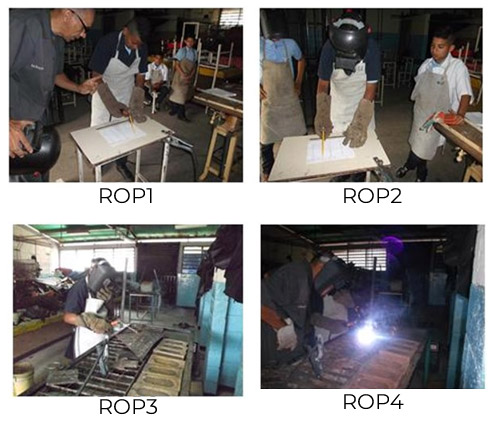
When reviewing the records of the participant observation, it was possible to appreciate the pedagogical act of a teacher identified as V02MO, who in a welding class performs an innovative strategy to introduce students to the learning of "welding". In the absence of simulator resources for this dangerous learning competition, students (without putting on the welding mask) go to the cubicles where the equipment and the welding machine are located; There they proceed to connect the ground clamp to the table and in the other clamp where the electrode or rod is placed, they replace it with a graphite pencil; on the table, they place a notebook and on a sheet of paper they begin to make different types of cords according to what is stipulated in the sheet of pedagogical activities for the realization of the practice. (ROP1).
This activity allows them to exercise the various movements used to make the different cords. They then proceed to put on the mask (with which they have no visibility), and on another sheet of paper, they perform the same practical operation again (ROP2). Once finished, they proceed to compare the written fabrication simulation design of the different types of beads made in the two stages in order to verify the perfect possible alignment of the drawn beads, with which the student not only gains confidence and memory but also exercises his competence safely. Next, they move to the work area where they make the same design but with the welding instruments in connection (ROP3 and ROP4). See figure 1, where the images of ROP1 to 4 are shown.
This observed experience represents a didactic strategy generated and implemented by the teacher in the face of a situation that seemed to be limiting the learning process, such as not having the appropriate equipment and resources. The willingness to achieve in his students the pedagogical practices linked to his technical-operational competencies of industrial education allowed him to choose, plan and creatively develop with existing resources a satisfactory learning experience, which will undoubtedly be the reflection of a challenging attitude but also of daring towards innovation, every time that an innovative teacher is able to transform himself and make students participate creatively in their classrooms (Rojas-Carrasco, 2019).
Figure 1: Image Sequence of a welding class where the teacher executes an innovative strategy to introduce students to the learning of “welding.”
There is no doubt that an innovation-oriented education represents one of the highest challenges of the 21st-century society, to urgently target the macro sustainable development goals of the 2030 agenda. The demand for knowledge, job training, and the use of technologies will not be enough if citizens are not prepared for the creation, entrepreneurship, transformation, and change of themselves and of an environment that allows coexistence and well-being for all.
In this scenario, technical education in developing countries such as Venezuela is presented as a space of first-order for effective transformation through the preparation of the person to create in a productive world, where creativity and human talent are of more interest than raw materials and the profiling of specific labor jobs. Hence, the key to educating for innovation is to be innovative; as UNESCO (2016) refers that innovation is not so much a product but a process and an attitude, as there is the purpose of developing students' innovation competencies, which are the learning outcomes that refer to knowledge, skills, and attitudes necessary for successful innovation activities (Kairisto et al.,2012).
The ethnographic experience recognized by the teachers of the Industrial Technical School "La Carucieña" shows us that the essence of being innovative in the pedagogical act is the teacher since their students will be the reflection of the attitude towards the need to "improve," to incorporate changes and the dedication to overcome the education of routine and inertia. Iglesias et al. (2018) say the teachers are the ones who can choose the most correct and beneficial option for their students, and even if they encounter difficulties and barriers along the way, they have to face them to demonstrate that the change or innovation they have carried out has worked and given the desired results or not. Because if no one goes off the beaten path, changes and innovates, education does not advance with society.
In this sense, we consider it necessary that in industrial technical education, reflective spaces are generated that allow us to point out curricular policies and strategies that lead to education less centered on the repetition of theoretical knowledge and more oriented to the formation of competencies for innovation. It is therefore required to develop of school culture to teach innovation and innovate to learn, where the contributions of students and teachers are promoted and recognized, while favoring autonomy and openness to experiment, because according to Martín-Gordillo and Castro-Martínez (2014), Innovative teachers and an organization that supports innovation are, therefore, the conditions to make possible the most important: that innovative skills occupy a central place in the training of children and youth.
Hence, the importance of "making visible" experiences such as the one presented in this article, since changes and transformations for a pedagogical action that promotes innovation is possible when teachers assume the will, intentionality, and mobilization of the "utopian conscience" proposed by Freire (1997); That is, when teachers are self-aware of BEING creative and emancipatory AUTHORS, they move away from being reproductive actors of a pedagogy based on conformism and passivity. Only in this way, industrial technical education may be presented as a path of hope for the many low-income Venezuelan students who choose to overcome the barriers of poverty through education for and on the job.
Antiche, J. (2012) El laboratorio-taller de mecánica automotriz como espacio de aprendizaje en las escuelas técnicas. Revista Educare UPEL IPB.16. (1) 71-97. https://revistas.investigacion-upelipb.com/index.php/educare/article/view/197
Asamblea Nacional de la República Bolivariana de Venezuela. (2009). Ley Orgánica de Educación. Venezuela: Ministerio del Poder Popular para la Comunicación y la Información.
Blanco, R. (2005). Versión preliminar del Módulo “La escuela como centro de la innovación educativa”. UNESCO
Cobo, C. (2016) La Innovación Pendiente, Reflexiones (y Provocaciones) sobre educación, tecnología y conocimiento. Montevideo, Uruguay: Colección Fundación Ceibal.https://revistas.unc.edu.ar/index.php/vesc/article/view/16236
Cuello, P. (2006). La Educación técnica industrial y para el trabajo y las exigencias del mercado laboral. Revista Investigación y Postgrado, 21(1), 11-48.http://ve.scielo.org/scielo.php?script=sci_arttext&pid=S1316-00872006000100002
Drucker, P. (2000).Business Technology.En M. Mejía (Ponente),II Encuentro de Experiencias Educativas de Innovación: La integración curricular una propuesta de transformación educativa” Bucaramanga, Colombia: Fe y Alegría - Universidad AutónomaBucaramanga.http://centroderecursos.alboan.org/ebooks/0000/0705/6_FyA_INT.pdf
Fundación Codespa. (2014). Se celebra la edición 2014 de la Cumbre Mundial para la Innovación en Educación (WISE). https://www.codespa.org/blog/2014/11/14/se-celebra-la-edicion-2014-de-la-cumbre-mundial-para-la-innovacion-en-educacion-wise/
Freire, P. (1997).Pedagogía de la autonomía. Buenos Aires. Ediciones Siglo XXI.
Geertz, C. (1992). La interpretación de las culturas. Barcelona, España: Gedisa.
Ibarrola, M. (2010). Dilemas de una nueva prioridad a la educación técnico profesional en América Latina, un debate necesario. La educ@ción Revista digital, (144), 1-29.http://www.educoea.org/portal/La_Educacion_Digital/144/articles/mariadeibarrola.pdf
Iglesias, M.; Lozano, I. & Roldán, I. (2018). La calidad e innovación educativa en la formación continua docente: un estudio cualitativo en dos centros educativos. Revista Iberoamericana de Educación, 77(1), 13-34.https://doi.org/10.35362/rie7713090
Kairisto, L.; Räsänen, M.; Lehtonen, J. & Lappalainen, H. (2012). Pedagogía de la Innovación – aprendiendo con métodos activos multidisciplinares. Revista de Docencia Universitaria, 10(1),67-86.https://doi.org/10.4995/redu.2012.6122
Maldonado-Fuentes, A. & Rodríguez-Alveal, F.(2016). Innovación en los procesos de enseñanza-aprendizaje: Un estudio de casos con la enseñanza justo a tiempo y la instrucción entre pares. Revista Electrónica Educare,20(2), 1-21. http://dx.doi.org/10.15359/ree.20-2.14
Martín-Gordillo, M.& Castro-Martínez, E. (2014). Educar para innovar, innovar para educar. En D. Pulfer (Director OEI), Congreso Iberoamericano de Ciencia, Tecnología, Innovación y Educación. Universidad de Buenos Aires, Argentina.https://www.researchgate.net/publication/280597980_Educar_para_innovar_innovar_para_educar
Mogollón, L. (2015). Curso Innovación Educativa y sistematización reflexiva de buenas prácticas pedagógicas. Módulo 1.Lima.UNESCO.https://es.slideshare.net/paulo910/modulo-1-innovacion
Naciones Unidas. (2018). La Agenda 2030 y los Objetivos de Desarrollo Sostenible: una oportunidad para América Latina y el Caribe. Santiago de Chile, Chile: Naciones Unidas.CEPAL.https://www.cepal.org/es/publicaciones/40155-la-agenda-2030-objetivos-desarrollo-sostenible-oportunidad-america-latina-caribe
Organización Internacional del Trabajo. (2001). Modernización de la formación profesional en América Latina y el Caribe.Montevideo, Uruguay: CINTERFOR.https://www.oei.es/historico/etp/modernizacion_formacion_profesional_AL_cinterfor.pdf
Piñero,M.; Rivera,M. & Esteban, E. (2020).El proceder del investigador cualitativo. Precisiones para el proceso de investigación. Lima, Perú: Ediciones de la UNHEVAL-UPEL-IPB. https://doi.org/10.46498/upelipb.lib.0001
Rojas-Carrasco,O. (2019) El rol del maestro en los procesos de innovación educativa. Revista Scientific. 4 (Especial) 54-77. https://doi.org/10.29394/Scientific.issn.2542-2987.2019.4.E.3.54-67
Ramírez, A. & León, A. (2012).La enseñanza en la educación media técnica. Anuario del Doctorado en Educación: Pensar la educación, Numero 6, pp. 32-57. http://erevistas.saber.ula.ve/index.php/anuariodoctoradoeducacion/article/view/4357
Robalino, M. & Eroles, D. (2010). Nuevos tiempos, nuevos desafíos: calidad de la Educación con enfoque de derecho e innovaciones educativas. Oficina de UNESCO, Quito y Red Innovemos (OREALC/UNESCO). Presentación para el Encuentro “Educación e Innovación 2010”, organizado por el Ministerio de Educación de Ecuador y VVOB, 2 y 3 de diciembre 2010, Cuenca, Ecuador
Sevilla, M.(2017).Panorama de la educación técnica profesional en América Latina y el Caribe.UNESCO-CEPAL.https://www.cepal.org/es/publicaciones/40920-panorama-la-educacion-tecnica-profesional-america-latina-caribe
Simone, J. (1993). Papel de la educación técnico-profesional en el mejoramiento de las capacidades de los trabajadores del sector moderno ante los procesos económicos actuales y los nuevos desarrollos tecnológicos. Revista Iberoamericana de educación, (2), 149-177.https://dialnet.unirioja.es/servlet/articulo?codigo=1019361
UNESCO. (2015). Educación 2030. Declaración de Incheon y Marco de acción. República de Corea: Organización de las Naciones Unidas para la Educación, la Ciencia y la Cultura. https://unesdoc.unesco.org/ark:/48223/pf0000245656_spa
UNESCO. (2016).Innovación educativa. Serie “Herramientas de apoyo para el trabajo docente”. Texto 1. Lima, Perú: Editora y Comercializadora CARTOLAN E.I.R.L.http://repositorio.minedu.gob.pe/bitstream/handle/MINEDU/5135/Innovaci%C3%B3n%20educativa.pdf?sequence=1&isAllowed=y
Velasco, H. y Díaz, A. (2006). La lógica de investigación etnográfica (6ta. ed.). Madrid, España: Editorial Trotto S.A.
Fe y Alegría. (1995). Educación en y para el trabajo liberador y productivo. En XXVI Congreso Internacional. Caracas: Federación Internacional de Fe y Alegría.